Home/Our Services/Storm Drain Rehabilitation/Problem Signs/Sinkholes Near Storm Drains
PROBLEM SIGN · STORM DRAIN REHABILITATION
Sinkholes near storm drains are a surface symptom of a growing underground void.
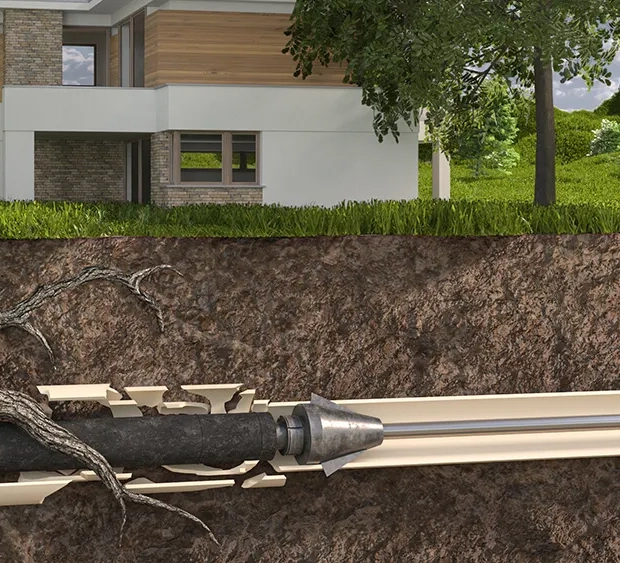
Surface depressions and sinkholes forming near storm drain inlets, along pipe routes, or near manhole rings indicate that void formation is occurring underground — caused by water infiltrating through failed pipe joints carrying fine soil particles with it. The void grows with every storm event until the surface can no longer support it.
Free phone consultation. Flat-rate pricing. No upsells, ever.
We'll call you back within one business hour. No automated systems.
FROM PIPE FAILURE TO SINKHOLE
How a failed storm drain joint becomes a parking lot sinkhole.
Sinkhole formation near storm drains follows a predictable progression — starting with pipe joint failure and ending with surface collapse if the failed joint is not rehabilitated.
Failed pipe joint allows water to enter surrounding soil
During storm events, flow pressure at failed joints forces water through the joint opening into the surrounding soil — establishing a flow path that persists between storm events.
Repeated water flow through soil carries fine particles toward pipe
With each storm event, water moving through the soil toward the failed joint carries fine-grained soil particles — progressively removing material from the soil matrix above and around the pipe.
Void forms above the failed joint as soil particles are removed
Progressive removal of fine particles creates a growing void in the soil above the failed joint. The void grows with each storm event until it reaches a critical size.
Surface collapses when the soil arch above the void fails under loading
Sinkholes appear when the soil remaining above the void can no longer support the surface load. Surface loading, rainfall, or continued void growth triggers the collapse.
Why sinkholes near drains require urgent pipe assessment.
Once void formation is confirmed above a failed storm drain joint, the rate of void growth accelerates — each storm event removes more material, and the cost and complexity of remediation increases with void size.
Pipe rehabilitation stops void growth by eliminating water infiltration through the failed joint
CIPP lining seals the failed joint that is generating the void-forming water infiltration — stopping the fine-particle transport mechanism that is growing the void.
Smaller voids can be pressure-grouted from the surface after pipe rehabilitation
Smaller voids detected early can be filled by pressure grouting through the surface after pipe rehabilitation — restoring soil bearing capacity without excavation.
Larger voids may require excavation to restore bearing capacity — but pipe can still be lined first
Even where the void is too large for surface pressure grouting, CIPP lining the failed pipe first stops void growth before excavation begins — simplifying the excavation scope.
Storm drain system characteristics associated with sinkhole formation.
Sinkhole formation near storm drains is most common where pipe joint failure occurs in granular soils — where fine-particle transport is most efficient.
Granular (sandy or gravelly) soils above failed pipe joints
Sandy and gravelly soils allow efficient fine-particle transport through joint openings — making void formation faster and more progressive than in cohesive clay soils above failed joints.
Large-diameter storm drain pipes with significant joint openings
Large-diameter segmental pipe systems have proportionally larger joint openings when separation occurs — allowing more efficient fine-particle transport and faster void formation.
High storm flow velocities increasing joint pressure during events
Storm drain systems carrying high-velocity flows during peak events experience elevated pressure at every failed joint — accelerating the rate of fine-particle transport and void formation.
Aging mortar joint systems with complete mortar deterioration
Older concrete pipe systems with mortar joints that have fully deteriorated have large open annular spaces at every joint — creating the most efficient possible fine-particle transport conditions.
Church property parking lot — sinkhole near drain inlet addressed with CIPP and surface grouting.
A Charlotte church property had developed a sinkhole approximately 4 feet in diameter near a storm drain inlet in the main parking lot — forming over approximately one storm season. Camera inspection found significant joint separation at two locations in the storm drain run beneath the affected parking lot area.
LiningWorks CIPP-lined the storm drain run through existing manhole and inlet access, sealing both identified joint separation locations. Surface pressure grouting through the parking lot surface filled the void. Post-installation camera confirmed full liner bond at both previously failed joints. No further surface movement has occurred.
P
Church Facilities Manager
Charlotte, NC · Google
G
★★★★★
“4-foot sinkhole in the parking lot near the storm drain inlet. Camera found two failed joints underneath. LiningWorks lined the pipe through existing access, we grouted the void from the surface, and the parking lot is solid. No excavation, no pavement replacement.”
Every review below is posted directly on Google by verified customers.
BM
Brad Moore
North Carolina
We had a plumbing emergency around the holiday's and called a local plumbing company. They cleared the line and quoted a pretty high price to dig up my yard and fix the damaged sewer line. The next day I found LiningWorks online and called Jeremiah. He was very helpful and confident they could fix my sewer line without digging. Seemed too good to be true. The lining has been installed, yard not damaged and looks to have resolved the break. Jeremiah even offered to come back and scope it at a later time to ensure it's all good. Highly recommend Lining Works for any situation where you can't or don't want to dig. Thanks guys!
RB
Ron Berardi
North Carolina
LiningWorks was top notch. We had a sewer main that got damaged and was completely blocked up. They were able to clear the drain, remove all issues, and reline the entire sewer main without cutting out my driveway and yard. And they were able to get the job done in one day. I would and plan to do business these guys again in the future and would highly recommend them to others.
CW
Cole Why
North Carolina
Where do I begin? Let's just say I had an absolute nightmare on my hands for about 5 years with my sewage. I had one company quote me 7k after he snaked my sewage line and from there I just kept snaking it every year. I dreaded the oncoming financial disaster but I bit the bullet and called LiningWorks. BEST home decision of 5 years. Jeremiah came out and tackled this chaos with grace and integrity. He got down to the root of it — after years of money, anxiety, and frustration he found out it was a city problem! I will definitely be calling LiningWorks when my lining needs replacing. Call them now, you will not be disappointed.
MG
Martin G
North Carolina
Hired them to redo the pipes at my home because they were old. They were very polite, answered all my questions thoroughly and did an AMAZING job. Jeremiah was the very best that I could ask for and highly recommend his services. Extremely satisfied with the work done. Thanks again Jeremiah!
JB
James Buffington
North Carolina
I am very happy with the work that was done and the clean up after the job was done. Jeremiah and Ralph are very professional and skilled in their craft. I received an estimate and the job did exceed the original estimate. I contacted them about it and they were very understanding and explained why.
GS
Garret S.
North Carolina
Lining Works was excellent to work with. They were perfectly professional. They were organized, efficient, and friendly throughout the whole process. They took time to answer all of our questions. Pipe lining is an incredible option and the team at Lining Works couldn't have been better. They were also transparent, honest, and consistent with their cost/pricing. We couldn't be happier. We feel very fortunate that we found Lining Works. Great guys!
NO
Nate O.
North Carolina
The main drain line in our airbnb kept clogging up, filling the house with an awful sewage smell. We had drain cleaners come out to clear the line every couple months but it finally got so bad we had to close off our bookings. LiningWorks were very prompt in coming out. We discovered tree roots had broken up our line. Our sewage line runs under a tree and 6ft deep through our crawlspace so digging it up was going to be a nightmare. Liningworks was able to cut the tree roots out and line the pipe without any digging so that it's as good as new. Would definitely recommend them to anyone needing sewage line repair.
JL
Justin L.
North Carolina
Lining Works responded to my request quickly and fixed my drain problem very fast. I would highly recommend you give them a call.
Stop the void — rehabilitate the pipe before the sinkhole grows.
Sinkhole formation near storm drains starts with pipe joint failure. Rehabilitating the pipe stops the void growth mechanism — then surface grouting addresses the existing void.
Camera locates all failed joints in the sinkhole zone
CCTV inspection identifies every failed joint beneath the sinkhole area — ensuring the CIPP lining scope covers all active void-generating infiltration sources.
CIPP lining seals all failed joints and stops void growth
CIPP liner seals every joint opening in the affected pipe run — eliminating the water infiltration that is continuing to transport fine particles and grow the void.
Pipe rehabilitation through existing storm drain access — no excavation of sinkhole area
CIPP installation is performed through existing manholes and inlets — avoiding any excavation that would further disturb the void zone during pipe rehabilitation.
Pre- and post-rehabilitation documentation for property records
Camera documentation of failed joint locations before rehabilitation and full liner bond confirmation after — objective record for property insurance and maintenance files.
Get sinkhole-causing pipe failure addressed in three steps.
Camera locates the failed joints — CIPP seals them before the void grows larger.
01
Call and describe the sinkhole location and timeline
336-477-3218, Mon–Sat 7AM–6PM. Sinkhole size, proximity to drain inlets, timeline of development — describe what you're seeing and we'll assess urgency and schedule the camera assessment.
02
Camera locates all failed joints in the pipe run beneath the sinkhole
We scope the storm drain system beneath the sinkhole area, identify all failed joints, and develop a CIPP lining scope that covers all void-generating infiltration sources.
03
CIPP lining stops the void growth — surface grouting fills the existing void
CIPP liner through existing access seals all identified failed joints. Post-installation camera confirms full liner bond. Surface pressure grouting fills the existing void without excavation.
Let’s talk about something most homeowners would rather not: what’s going on under your lawn. You’ve got this quiet, shady maple out front. Maybe you’ve even named it—something cha
If you’re reading this, chances are something’s not quite right under your feet. Maybe the drains are backing up. Maybe the yard smells like something crawled down there and gave u